
Sachin G Kulkarni


Recently, someone tried building an education platform using AI.

At first, it looked impressive. Features were coming in fast. Progress felt great.

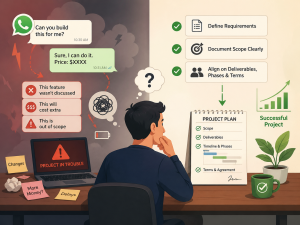
But after a month, things changed. Every new update introduced more bugs than features.

The code started conflicting with itself. Lot of repeated codes. Timelines slipped. Control was lost.

Most business apps follow the same pattern: Add. Update. Delete. List.

And then comes the “list” screen with a data grid…which is often too basic to be useful.

No proper filtering, Limited sorting, Barely any control over data.

So what do users do? They export to Excel. If excel sheet make their workflow better then why should your product exist.

A friend told me he found a service offering website development for ₹500/month.

Sounds like a great deal, right? I told him not to go for it. Because here’s what usually happens with these models:

  • Same template reused for dozens of clients
  • Built by interns or fully AI-generated with minimal thought
  • Slow performance and poor structure
  • Weak or delayed support once they scale clients

And the real cost shows up later:

  • Low conversion from ads become of poor user experience
  • Eventually rebuilding the entire website

I said “ You don’t save money.You just delay the expense.” He took the advice.

AWS-Credits

I see many early-stage non tech founders jumping straight to AWS or GCP.

Mostly because of “free credits.” Honestly, that’s a trap.

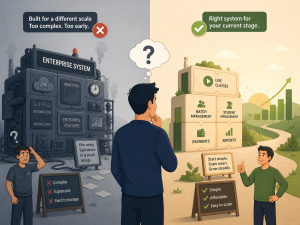
At that stage, you don’t have a scaling problem. You have a customer acquisition problem. A simple VPS is more than enough:

  • It’s cheaper
  • Easier to manage
  • No unnecessary complexity

But cloud platforms make you think like you’re building for millions…when you don’t even have your first 100 users.

restaurant POS

A year ago, someone bought a restaurant POS from CodeCanyon.

They came to me for one key addition: reports. Sounds simple.Until I looked at the code.

The UI looked premium…But the data layer was a mess.

  • No proper structure
  • Missing critical fields like created date
  • No consistency in how data was stored

And that’s when it became clear: Building proper reports would cost more than what they paid for the entire software.

Recently, my friend Sagar Moudgal shared a very practical way of thinking about mid-career transitions using Ikigai. What stood out to me was how actionable they were. This is not about quitting your job and taking a blind leap. It’s about evolving with clarity and control.

I noted down the key ideas and tried to structure them so they can actually be applied in real life. Let me walk you through it these actionable 11 steps for you.

1. Understand Why You Want to Transition

Most transitions don’t start with logic. They start with a feeling that something is missing.

We all know that automating business activities is a game-changer. It’s no secret how beneficial it can be for any business. But let’s be real—it’s not the idea that’s the challenge, it’s the “how” that’s tricky.

Where do you even start? How can you do it without breaking the bank? And how do you make sure your efforts don’t flop? These are the questions that make automation seem daunting.

In this article, I’m going to share a few tips on how you can get started with automation in your business. I’ve developed business applications across multiple industries, so I’ve picked up some solid insights along the way.

I’ll show you how to make your automation efforts truly worth the investment. Let’s dive in and get your business running smoother and more efficiently!

OroCommerce is a new kid in the block that is changing both B2C & B2B e-commerce with its amazing features.

OroCommerce is built to work for One Seller & multiple buyers’ pattern.

Hum…. that’s not what marketplace is. The marketplace is about multiple seller & multiple buyers

O! Ya… you are right.

Let me say this right away – OroPlatform is best to build a multi-tenant b2b business app and you will find why in this write-up.

For those who don’t know what OroPlatform is, here is the quick introduction

OroPlatfrom is a Business Application Platform which has a multi-tenant architecture built into it. Just not that, It is Open Source Business Application Platform (BAP) built on top of proven PHP framework – Symfony.  Its frontend architecture is very well built around JQuery & Backbone JS (Chaplin JS to be particular)

With that said, I would further explain why OroPlatform is the best for SaaS Apps – without being too technical.

On-demand service industry has been growing in India. Today we have on-demand service starting from cabs to laundry. This is catching up a trend among the new generation as it makes their life easy. Soon things like getting a haircut, fixing a tap becomes a part of on-demand service industry.

Say you have a great idea that would be a part of on-demand service economy, and then you need to know just two things to get started – a business knowledge of your industry and technologies you need to run your business. This blog is all about the latter one.

On demand service

Mobile app for all participants

Most of the on-demand services operate by making aggregation of local services in their industry. In simple sense business make a tie-up or an agreement with the other business entity or individuals at different locations. These business entity or individuals are called vendors.