
Sachin G Kulkarni


I’ve seen this happen too often.

A client shares a brief idea.The developer replies with a price on WhatsApp.

There will be No requirement document , No scope clarity, No defined deliverables.But sill the project starts.

Everything looks fine… until midway. That’s when things begin to surface: “This feature wasn’t discussed” , “This will cost extra” , “This is out of scope”

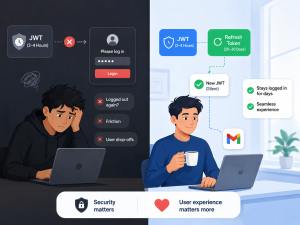
Most SaaS products get authentication almost right.

They use JWTs. That’s correct implementation, but either:

  • Tokens expire too quickly, so users get logged out constantly
  • Or they last too long, creating security risks

What’s usually missing? A proper refresh token implementation.

In a recent audit, I spotted this exact issue.The JWT token was set to expire after 6 hours, with no refresh token mechanism in place.

My client said, “Let users explore first.”

I didn’t agree. “If users skip setup, they won’t reach the wow moment.” That was my point in the meeting

Instead of just pushing back, I showed them:I signed up on competitor products and walked them through how onboarding is done right.

That’s when it clicked. After 30 mins of discussion he understood the importance of onboarding flow.

Recently a new client asked me to review a product built by another developer. He had outsourced it to some development agency.

Everything looked fine , untill I tested it.

I was able to delete a category that was already linked to products.It didn’t show any warning.

People say, “tester missed it.” But this was an issue in all modules.

Few month ago, I got a call from a consultant for a Shopping Mall in Bhopal. They had upcoming Lucky Draw Contest in their Shopping Mall

They wanted a simple solution. They wanted a way allow buyers to register themselves when they purchase for more than Rs 5000. Then they want to generate the Lucky Draw coupons and print them.

Why Print ? Why not Paperless – It was just to align with buyer’s mindset. They want to print the coupon and make buyers to drop it in the Lucky Draw Contest box.

I create a simple solution using combination of Google Forms , Google Sheets.

How many mobile app did you install last month ? For most people it’s zero. So what makes you to think that your new brand’s app get installed by your customers ?

At the start, your idea is still maturing. You would be doing lot of updated and bug fix every day.

Mobile app store approval become a barrier. You cannot push the changes instantly. It will slow down your development and time to market.

Best approach is to build PWA = Progressive Web App. In most case, that’s more than enough.

If you’re a non-tech founder outsourcing your product development, pay close attention to this 👇

Your app may look perfect during testing. Clean UI. Smooth flow. Everything feels “done.” You release payment, feeling confident.

Then production hits.

Users from different countries start using your app… and suddenly things break in subtle, frustrating ways:

I’ve seen this mistake in multiple products.

User clicks “Resend OTP”… System generates a new code every time. Sounds correct, right?

But here’s what actually happens:

  • SMS gets delayed
  • User clicks resend
  • New OTP is generated
  • Old OTP arrives first
  • User enters it and get “Invalid OTP” error

From the user’s perspective, your system is broken.

While building a matrimonial platform recently, we hit a small but important decision: How should we capture height? Feet or centimetres?

Client’s suggestion was to give both options and let users choose. That’s a complex UI – I said

I proposed something different.

  • Let’s Capture it in centimetres (global standard)
  • And show instant conversion to feet beside the input.

Why? Because the product wasn’t just for India. It was meant for cross-border matchmaking.